

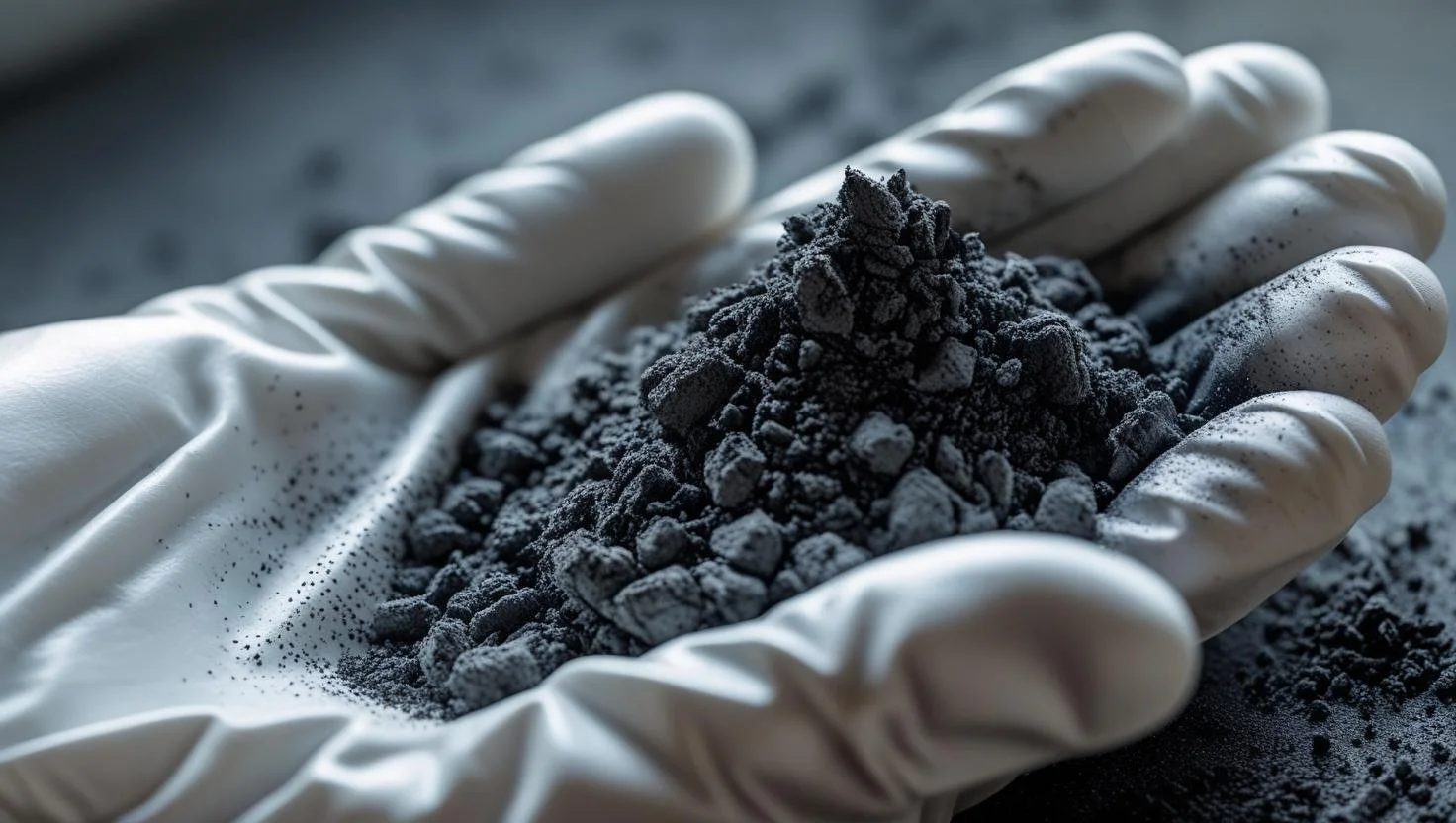

Engineering the End of Sludge
What is DRACO?
Our customers produce biogas from various organic wastes, including sludge and many began to adopt Thermal Hydrolysis Process (THP) technology to increase biogas production. However, those who utilize THP to obtain more biogas have to use more energy sources like electricity and LNG. Considering the operational costs, facility expenses, and maintenance efforts associated with extra energy input, is it truly beneficial to use THP solely to obtain more biogas?
As a supplier of DRACO THP, Tomorrow Water has been contemplating this question and began exploring ways for this technology to contribute more meaningfully to society. With this approach in organic waste industry, Tomorrow Water discovered that the rising costs of sludge disposal, rather than increasing biogas output, are the biggest pain point for our customers.
Ever since, we have been committed to evolving DRACO into HydroThermal Carbonization (HTC) instead of just sticking with THP technology.
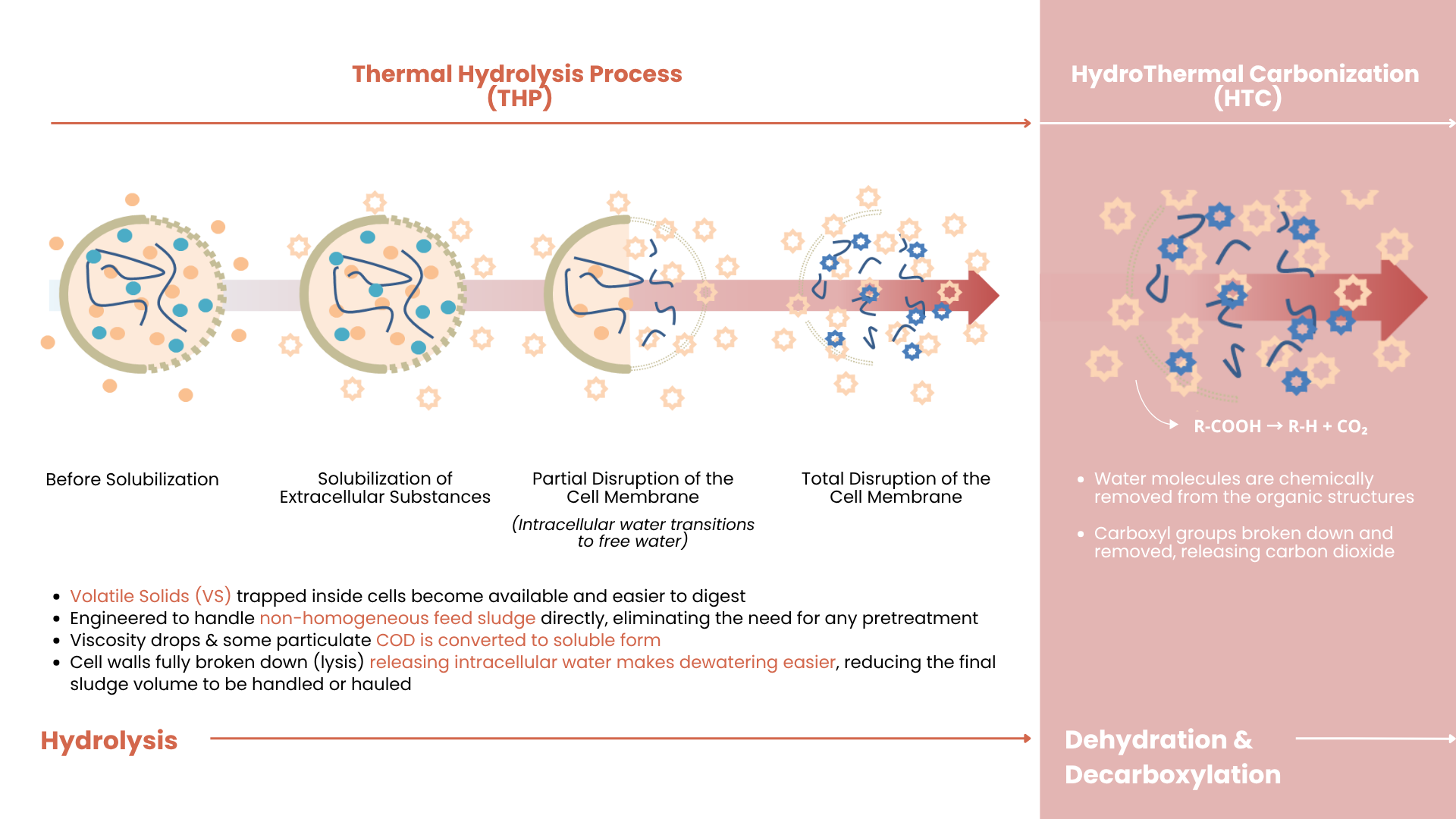
By applying a little more energy to increase temperature and pressure, DRACO HTC can reduce sludge by up to 80% and adding a dryer at the end can cut sludge volume by as much as 90%. It encompasses the hydrolysis stage implemented by THP and extends to dehydration and decarboxylation. As a result, DRACO HTC destroys the cells within the sludge, completely dewatering and removing the water trapped inside, thereby significantly reducing sludge volume. While reducing sludge volume, HTC also enhances biogas production, a feature initially present in THP.
These result in greater economic benefits for our customers.
The DRACO technology that Tomorrow Water possess can realize both THP and HTC.
We constantly reflect on what truly benefits our customers and are always thinking ahead.
Don’t just settle for THP, take a step further and experience DRACO HTC.
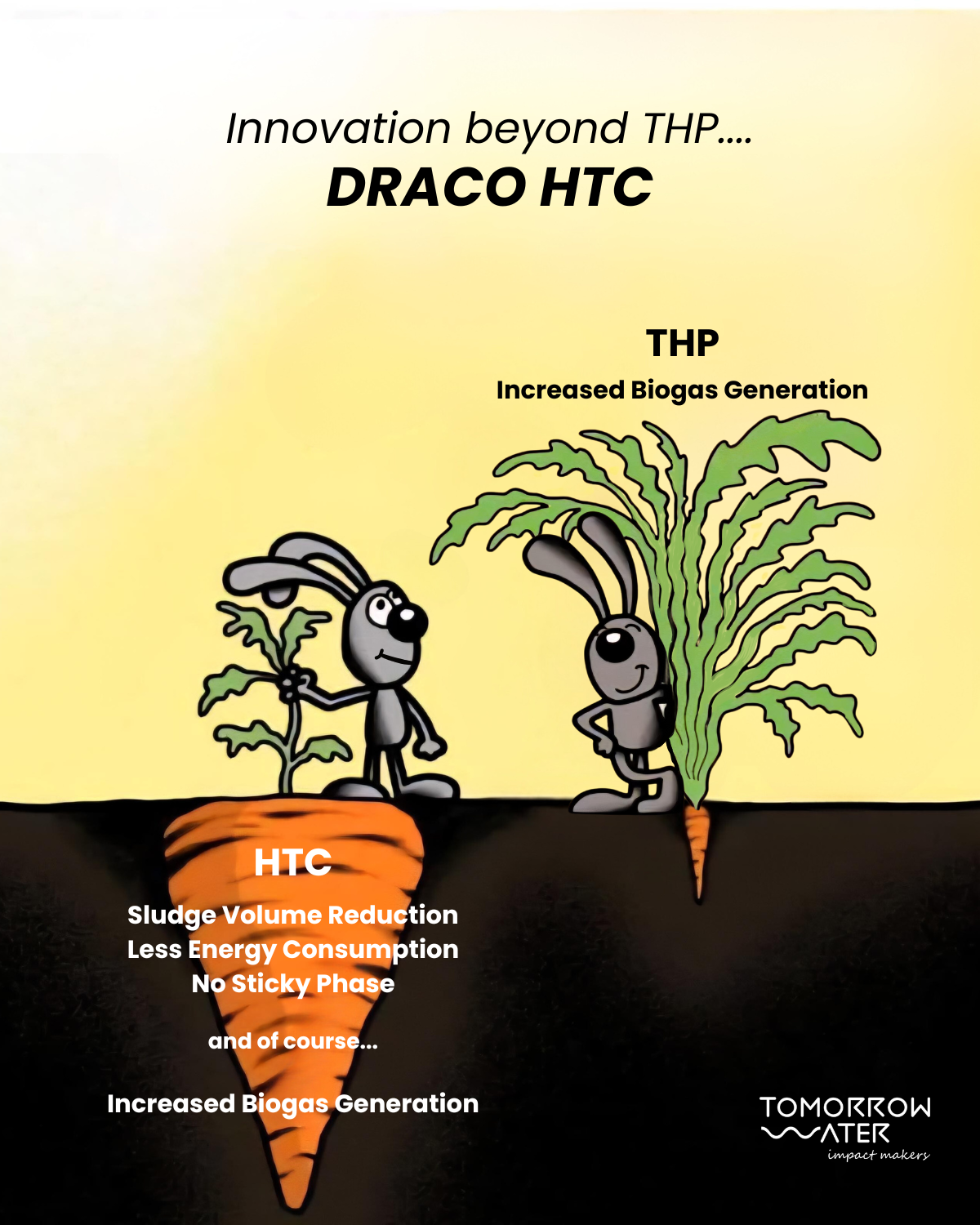

DRACO Reactions
DRACO HTC undergoes the same initial hydrolysis phase as DRACO THP, followed by dehydration and decarboxylation to complete the reaction process.
| DRACO HTC | DRACO THP | ||
|---|---|---|---|
| Primary Objective |
|
Boost Biogas Production | |
| Application |
|
Pre-Anaerobic Digestion | |
| Operation | Temperature | > 190 °C | < 170 °C |
| Pressure | 12 Bars | 7 Bars | |
| Reaction Time | 30 min | 20 min | |
| Sludge Characteristics | Input Dried Solid | > 20% | > 20% |
| Output Dried Solid | ~ 66% | - | |
| Performance | Increased Biogas Generation (Compared to AD without DRACO) |
~ 30% | ~ 50% |
| Sludge Volume Reduction (%) | ~ 80% (~ 90% with dryer) |
- | |
DRACO HTC vs. THP
DRACO HTC Applications
DRACO is a HydroThermal Carbonization (HTC) solution for sludge volume reduction. It reduces sludge volume by 80% and up to 90% with a dryer preventing sticky phase reducing overall energy costs.
When combined with an anaerobic digestor, DRACO system increases biogas production by over 30% .
DRACO HTC can also be integrated with heat-generating plants such as incinerators, coal-fired power plants, and cement plants. By utilizing waste steam from these facilities as a heat source, it operates without the need for external energy input.
In addition, DRACO HTC retrofits existing sludge dryer process, eliminating sticky phase issues, stabilizing dryer operation, and reducing 70% of energy costs.
-

Less Sludge, More Biogas
-

Sludge Reduction, Zero Energy Bill
-

Retrofit Your Dryer: From Old to Optimal
Seohae Green,
South Korea
One & Only Zero-Energy
Sludge Reduction HTC Facility
in the World

Process
DRACO HTC (Sludge Reduction, Zero Energy Bill Application)
Capacity
Sludge Treatment Capacity: 120 ton/day
Steam Usage: 0.21 kg Steam/kg Sludge (21 tons/day)
Steam usage based on the following:
- Feed Sludge Water Content: 84%
- Sludge Temperature: 20°C
** Actual steam consumption may vary depending on the characteristics of the input sludge **
DRACO System Configuration
DRACO is a patented HTC system using a batch process with stepwise heating, pressurizing, cooling, and depressurizing of biosolids
Components:
Hopper
Pre-heating Tank
Reactors
Decompression Tank
Heat Exchanger
Filter Press
Inside the reactors

3D CFD (Computational Fluid Dynamics) Analysis using a supercomputer
DRACO can process sludge regardless of water content through effective mixing and high heat transfer efficiency, using a patented multi-point steam injection technology
Improved contact between sludge & steam through the use of an agitator
Enhanced heat transfer efficiency through patented multi-point steam injection technology
Uniform heat distribution enables complete reaction of organic waste
Heat transfer efficiency validated through 3D flow analysis
Performance: Sludge Volume Reduction
| Item | Feed DS | Cake (DRACO + F/P) |
SVR Rate (before drying) |
SVR Rate (after drying) |
|
|---|---|---|---|---|---|
| Municipal WWTP | Primary + WAS | 15.3 ~ 21.8% | 57.0 ~ 60.1% | 76.8 ~ 83.1% | 85.0 ~ 90.0% |
| WAS | 17.8 ~ 23.7% | 58.0 ~ 66.3% | 76.2 ~ 80.6% | ||
| Digested Sludge | 15.8 ~ 24.0% | 53.6 ~ 66.3% | 75.9 ~ 81.9% | ||
| Co-Digestion | Primary + WAS | 17.6 ~ 21.3% | 51.1 ~ 51.8% | 75.0 ~ 79.1% | |
| Livestock | WAS | 14.8 ~ 18.8% | 54.9 ~ 57.7% | 79.4 ~ 83.3% | |
DRACO Pilot Unit
Pilot proven. Scalable by design.

-
2 tons/day
-
2 × 20-foot-high cube containers including 3 vertical opening doors
All Package System: DRACO SKID, Steam Boiler, Dewatering SKID
-
Decompression Tank: U Stamp in accordance with American Society of Mechanical Engineers (ASME) Boiler and Pressure Vessel Code (BPVC)
Monitoring & Control System: Underwriters Laboratories (UL) Certification & American National Standards Institute (ANSI) Standards
-
More than 50% Dry Solid (DS) of final cake (achieving more than 80% of SVR)
► Including elimination of pathogens under Class A30% more biogas production
► Evaluate results with Biochemical Methane Potential (BMP) test


PFAS: Our Future Challenge.
PFAS, often called “forever chemicals,” are one of the toughest challenges in wastewater and sludge management.
Much of today’s sludge is still land-applied, unintentionally reintroducing PFAS back into soils. Research shows these compounds can only be destroyed under extreme thermal conditions, 900°C to 1200°C, far beyond the reach of conventional treatment.
This is where Tomorrow Water’s DRACO HTC plays a critical role. By reducing sludge volume by up to 90% and concentrating PFAS into a smaller, denser residual stream, DRACO HTC makes downstream processes like pyrolysis, gasification, and incineration more energy and cost-effective.
Together with utilities, researchers, and industry leaders, we can build collaborative pathways toward scalable PFAS solutions.
FAQs
Is DRACO Hydrothermal Carbonization (HTC) or Thermal Hydrolysis Process (THP)?
DRACO can be both HTC and THP depending on an operation set-up.
HTC: Temp. >190°C / Pressure ~12 bar / ~30 min THP: Temp. <170°C / Pressure ~7 bar / ~20 min
How much solids can DRACO process?
DRACO can process solids up to 23~25% while usual THP or similar systems can process around 12~16%
Does “sticky phase” become a problem within the system?
DRACO + Filter Press process solves the “sticky phase”
Does DRACO destroy PFAS?
DRACO does NOT destroy PFAS.
But DRACO can be an effective and economical pretreatment to PFAS issues. Due to its sludge volume reduction, PFAS can be concentrated into much smaller and drier sludge which enhances efficiency of downstream destruction (e.g., pyrolysis, gasification)
Is pre-treatment necessary?
It is case-specific but most of the time, No
DRACO Reference
| Operation | Annual capacity (tons DS/yr) |
Location (City, Country) |
Application type/Purpose |
|---|---|---|---|
| 2019 | 7,300 (100 wet tons/d @ 20% DS) |
Gimhae, Korea |
HTC - Operating Sludge volume reduction (w/o AD). Mixed municipal sludge and slaughterhouse waste |
| 2025 | 5,840 (100 wet tons/d @ 16% DS) |
Seosan, Korea |
HTC - Operating Application as a pretreatment to improve drying performance Municipal sludge volume reduction |
| 2028 (Booked) |
32,522 (495 wet tons/d @ 18% DS) |
Daejeon, Korea |
THP - Under Construction Increase biogas production (Pre-AD) Municipal WAS-only THP |
| 2029 (Booked) |
5,913 (90 wet tons/d @ 18% DS) |
Mokpo, Korea |
THP - In Design (P3) Increase biogas production (Pre-AD) Municipal sludge THP |
| 2029 (Booked) |
2,803 (128 wet tons/d @ 6% DS) |
Gwangju, Korea |
THP - In Design (P3) Increase biogas production (Pre-AD) Municipal sludge THP |
Talk to our product owner.
HI I’M
DANIEL
KIM

DRACO Product Owner

dk@tomorrowwater.com
1225 N Patt St
Anaheim, CA 922801
DRACO RESOURCES
-
-
-
-
DRACO TAG 2025 Presentation
-
Please check later!